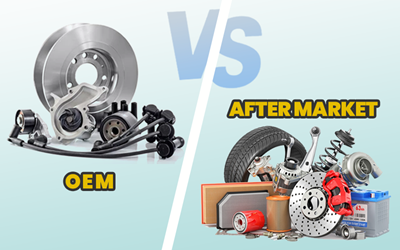
For hay producers, reputable aftermarket parts suppliers can offer lower repair costs, more sourcing options, and an economical way to keep older equipment working. The biggest benefit is value: getting a dependable repair at a reasonable total cost—not simply buying the cheapest part. Aftermarket quality varies, so the supplier and the specific component matter as much as the price.
Main benefits for a hay operation
| Benefit | What it means for the producer |
|---|---|
| Lower upfront repair costs | Aftermarket parts can cost less than OEM alternatives, making them useful for budget-conscious repairs and older or seasonal equipment. Savings depend on the particular part; there is no reliable blanket percentage for every repair. |
| Another option when the dealer is out of stock | Independent suppliers provide an additional sourcing channel. When the correct aftermarket part is available sooner than the OEM part, it can shorten downtime rather than leave the machine waiting for a backordered component. Availability still needs to be checked case by case. |
| More economical repairs on older machines | On an older baler, rake, or mower-conditioner, a lower-cost replacement may make continued operation more practical. Equipment dealer RDO specifically identifies older and seasonal equipment as sensible applications for aftermarket parts. |
| More choices in price and quality | Instead of a single OEM offering, producers may be able to choose among several manufacturers and quality levels, matching the purchase to the machine’s workload and expected remaining life. |
| Potential design improvements | Some aftermarket manufacturers offer revised materials or designs rather than a straight replacement. These can be worth considering, but an “upgrade” should be supported by specifications and a credible performance record—not just a sales claim. |
Why availability can matter as much as price
For a hay producer, the useful comparison is the total cost of getting back to work, not just the price on the invoice. Expected service life, installation time, reliability, warranty coverage, and the consequences of another failure all belong in that calculation. A less expensive part is good value only if it performs adequately; a readily available part can also be valuable when it avoids a long wait for the OEM alternative.
That also makes aftermarket suppliers useful as a second source rather than necessarily a replacement for the dealer. Comparing both channels lets the producer weigh actual stock, delivered price, fit, support, and warranty for each repair.
Where to be selective
A sensible approach is to evaluate aftermarket options for routine replacements and older, out-of-warranty equipment, while being more cautious with safety-critical, precision-matched, or high-consequence components. Small differences in dimensions or materials can affect performance and cause additional wear, so “fits this model” is not enough by itself.
Before ordering, check:
- Exact compatibility with the machine and its configuration.
- The manufacturer’s reputation and the component’s specifications.
- Actual stock and delivery time—not merely a catalog listing.
- Warranty, return terms, and technical support.
- Whether any price saving could be outweighed by shorter life or repeat installation labor.
The strongest purchasing strategy is therefore part-by-part: use a trusted aftermarket supplier where it offers a verified fit and better overall economics, and retain the OEM option where its engineering assurance or support justifies the premium.
How to find reputable aftermarket farm equipment suppliers
The best way to find reputable aftermarket farm equipment suppliers is to build a short list, then verify how well each supplier handles fitment, product sourcing, and support—not just price. For hay equipment, model and serial-number matching is especially important because parts can change within a model’s production run.
1. Start with suppliers that know your equipment
Use several channels to identify candidates:
- Ask your independent farm-equipment mechanic and nearby hay producers which suppliers they use—and which have handled a wrong part or warranty claim fairly. Treat those conversations as reference checks, not just name gathering.
- Search an agricultural trade directory. Farm Equipment has a public Guide to Suppliers with replacement-parts and mowing-equipment categories. A listing is a starting point for research, not a quality certification.
- Look for catalogs organized around your actual equipment: round balers, square balers, mower-conditioners, disc mowers, or rakes. Detailed parts listings and cross-references make it easier to evaluate compatibility.
2. Make the supplier prove the part fits
Before requesting a quote, gather your machine’s make, model, serial number, OEM part number, and photos or measurements of the old part. Suppliers’ hay-parts catalogs illustrate why these details matter: baler belts require matching dimensions and construction, while rake components can require matching bolt patterns, handedness, and OEM cross-references.
Ask the supplier:
“Can you confirm this replacement fits my model and serial number, and show me the OEM cross-reference and relevant specifications?”
Prefer a clear, documented answer over “it should fit.” For example, Quality Farm Supply explicitly advises matching baler parts to the specific model and serial number, and Schmidt & Sons provides hay-equipment parts books and a Hesston-to-Case IH cross-reference.
3. Use the same screening questions for every supplier
Here is a practical checklist to use before placing an order:
| Ask | What you want to establish |
|---|---|
| “Who manufactures this part?” | Whether the seller can identify what it is supplying rather than relying on a generic “OEM quality” claim. |
| “Is it new aftermarket, rebuilt, or used?” | Exactly what condition and product category the quoted price covers. |
| “Is it physically in stock, and where will it ship from?” | Whether the promised delivery is based on actual inventory. |
| “What happens if you confirm fitment and it is wrong?” | Who pays return freight, whether restocking fees apply, and whether an installed part can be returned. |
| “What does the warranty cover?” | The duration, exclusions, claim procedure, and whether coverage is limited to the replacement part. |
| “Can I speak with someone familiar with this machine?” | Whether technical support goes beyond taking an order. |
Keep the answers with your quote or order confirmation. This gives you a consistent basis for comparing suppliers instead of comparing advertised prices alone.
4. Investigate a few candidates—not just one
These are examples to investigate for hay equipment, not blanket endorsements:
| Supplier | What they offer | Contact |
|---|---|---|
| Emerson Ag | Genuine, used, remanufactured, and custom-made parts. Lists parts for 1068, 1069, 1075, 1078, 1079, 1085, 1095, BW28, BW38, H9880, and Stackcruiser models. | Emersonag.com | 605-891-4966 | South Dakota | 40 Years Experience |
| Sod Buster Sales / New Holland Bale Wagon Parts | New and used parts, manuals, specifications, and troubleshooting support. Says it carries many otherwise unavailable parts. | newhollandbalewagonparts.com | 406-883-2118 | Polson, Montana | 58 Years Experience |
| Stackcruiser Parts | New and used parts for nearly every New Holland bale wagon model, with direct shipping. | stackcruiserparts.com | 208-519-0305 | 35 Years Experience |
| New Holland / MyCNH Store | Official parts lookup by model, serial number, part number, or keyword, with dealer pickup or delivery options. | New Holland’s official parts site | Since 1985 |
Supplier descriptions establish what these businesses advertise; they do not independently establish durability, service quality, or warranty performance.
5. Test the relationship before an urgent repair
My recommendation is to start with a small, nonurgent order. Evaluate whether the supplier confirms compatibility, ships when promised, delivers the stated brand and specifications, and answers follow-up questions. Use that experience to choose a primary supplier and a backup before hay season.
A useful reference question for another producer is: “What happened the last time something went wrong with an order?” That answer often tells you more about the relationship than a low price or a five-star rating.

New Holland Bale Wagon and Stackcruiser parts is our specialty but you can also discover everything you need to maintain and repair your hay and forage equipment in our Parts Store.